
Why Is My Cat Bullying My Other Cat? Understanding Cat-to-Cat Aggression
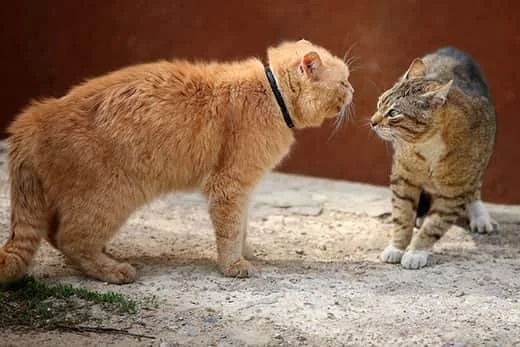
When someone emails me and says, "I think one of my cats is bullying the other," my first response is usually to ask a bunch of questions like: What have you actually seen? Is there fighting? Is one cat blocking the other from getting to the litter box? Is food being stolen? Is one cat pouncing on the other? Is there video footage you can send me?
I want to know what is actually happening in the home before we put a label on it. That's because "bullying" can mean very different things to different people. One person might consider strenuous play to be bullying, while another might not recognize classic signs of litter box guarding as a problem at all.
So before we try to fix anything, we need to drill down into the details. What are the cats actually doing? And if possible, can we document it with videos or logs?
Is "bullying" actually a helpful term?
I think the word can be helpful, but it can also be misleading - which, in itself, is not a particularly helpful statement. Oops!

We shouldn’t really apply heavily emotionally charged labels to our companion animals. Think about the word "bullying." When you hear it, you probably have a particular image in your head. Maybe you even remember a time when you were bullied. Now think about what happens when you apply that same emotional framework to your cat: Probably nothing great!
I think it's important to find language that is descriptive enough that we can communicate clearly with each other and with veterinary and behavior professionals, without anthropomorphizing the situation or adding emotionality that doesn't need to be there. I find that describing what is happening as clinically as possible is much more useful and that allows us to figure out what is actually going on.
For example, a lot of what people describe as "bullying" or aggression can actually stem from insecurity, fear, pain, or a perceived loss of control. But once we label a cat a "bully," we can become unsympathetic to what that cat may be experiencing emotionally or physically. And that's not helpful.
So what actually constitutes a problem?
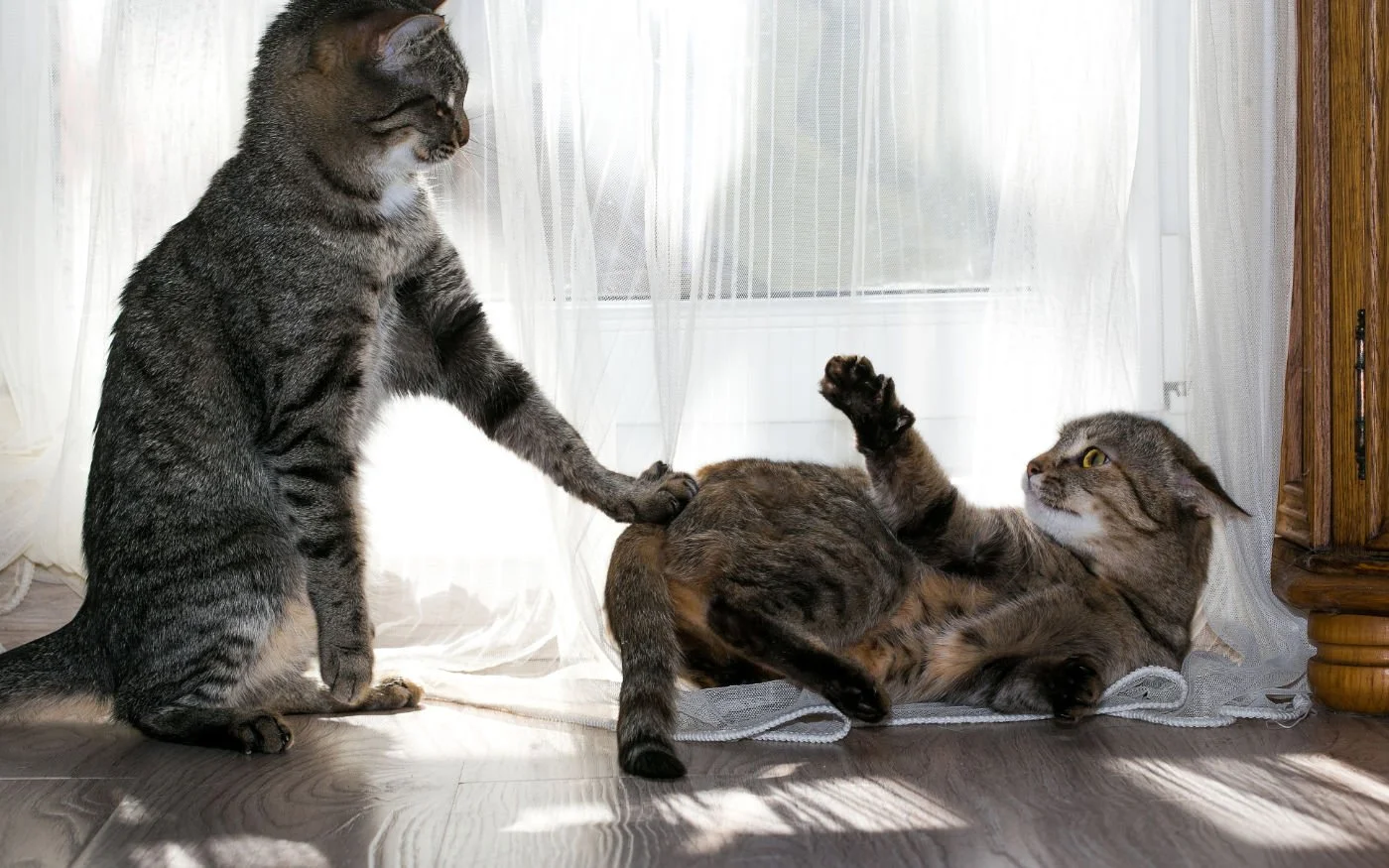
There are certain behaviors that make me much more concerned about a relationship between cats.
These can include:
Litter box guarding - blocking another cat's access to the box or attacking them when they try to use it
Food guarding
Blocking the tops or bottoms of stairs
Pouncing on another cat from around corners or in narrow hallways when it isn't play
Frequent mounting
Actual physical fighting
These behaviors tell us that something isn't working well in the relationship and deserves closer attention.
How can you tell play from fighting?
One of the easiest ways to distinguish play from fighting is sound. Play is almost always silent. There may be an occasional squeak of excitement, but even fairly rough play is generally pretty quiet. A real fight between cats is LOUD. You're much more likely to see yowling, hissing, growling, fur flying, and one cat fleeing while another pursues them. That's what you don't want to see.
Another concern is when two cats get caught in what I think of as a predator-and-prey loop. Cats are naturally both predators and prey, and it's surprisingly easy for two cats to start enacting those roles with each other. Once that happens repeatedly, the cycle can become increasingly entrenched. The more it happens, the tighter the loop becomes.
But my cats used to get along. Why are they suddenly fighting?
This is one of the most common things I hear from people: "They've always gotten along. What happened?" My first question is always: What happened around the time the fighting started?
Was there:
a visitor to the home?
construction or another major environmental change?
a vacation?
a new family member or pet?
a move?
a veterinary visit?
an illness?
a loss?
a change in their routine?
another cat appearing outside that they can see?
Generally, there is a reason this started.
And once the cycle begins, it can continue to circle around and tighten even after the original trigger is gone.
That's where behavior work can help: we can help break the cycle.
Is one cat really "the bully"?
Usually, that is an oversimplification. As I mentioned above, the cat who appears to be doing the bullying may actually be acting out of fear, insecurity, physical pain, or a perceived loss of control. It's not that your cat just decided to become an asshole!!!! That's not how cats work.
We need to look at a full history to figure out what happened to start the situation and what is maintaining it. Depending on the case, that might mean adding resources, increasing intellectual and environmental stimulation, separating the cats and gradually reintroducing them, using positive reinforcement, or some combination of those things.
What about the cat on the receiving end?

Sometimes the cat who is being targeted will show very obvious signs of stress. Other times, the changes are much more subtle.
Things I look for include:
House soiling
Avoiding food
Avoiding previously favorite areas of the home
Sleeping much more than usual
Hiding
Changes in routine
Changes in normal movement around the house
And one of the biggest things I look for is what I call acting like prey.
If your cat is suddenly moving around the house with tiny, fast movements, constantly anticipating and worrying about where the other cat is, that's a hallmark of this type of cyclical relationship.
You may never actually see a dramatic fight. But if one cat is constantly monitoring the other and changing their behavior because of them, that tells us something is wrong.
Don't forget about medical issues
Medical problems should always be part of the conversation when behavior changes suddenly. For example, house soiling should always be evaluated by a veterinarian first to rule out FLUTD and other physical causes. Pain can also be a huge driver of aggression and conflict between cats. A cat who is experiencing pain may behave very differently toward another cat - or toward the people in the household - than they normally would. That's why I don't want to look at a behavior problem in isolation. We have to look at the whole cat and the whole environment.
Please don't yell at your cats

One of the biggest mistakes I see people make when they witness conflict is: Yelling. Running toward the cats, clapping your hands, yelling, trying to scare them apart... I understand why people do it. When you see your cats fighting, your instinct is to stop it immediately. But punishment doesn't solve the underlying problem. It can also startle everyone involved and make the situation worse.
Sometimes separation is absolutely necessary in the moment. That's different from punishment. Separation can be an important safety tool, but separation alone generally isn't going to fix the relationship. We still need to figure out why the cats are having trouble and address that underlying issue.
Can cats who are fighting learn to get along again?
Absolutely.
I see cats with these kinds of relationship problems improve all the time. Generally, the first step is giving the cats enough time to come back down under threshold rather than continuing to expose them to situations where they're fearful, frustrated, or aggressive. From there, we can work on a gradual reintroduction, using a high-value reinforcer and carefully controlling the interactions.
We also need to look at the cats' everyday lives. Do they have enough intellectual and environmental stimulation? Do they have appropriate resources? Are they bored? Are they able to move through the home without constantly encountering each other? Sometimes the solution isn't just about preventing fights. It's about creating an environment where the cats have more appropriate things to do and more ways to feel secure.
The most important thing to remember
If there's one thing I wish every cat guardian understood about relationships between cats, it's that they are much more nuanced than we might think. It's very tempting to look at two cats and decide that one is "the bully" and one is "the victim." But cats don't fit neatly into those roles. There is usually a much more complicated story underneath the behavior.
The cat who is chasing may be afraid. The cat who is hiding may be stressed. A medical problem may have started the whole thing. Something in the environment may have changed. And once the cycle gets started, the cats may continue repeating it even after the original trigger is gone.
That's why I don't want to start with a label. I want to start with what the cats are actually doing.
Once we understand that, we can start figuring out why it's happening—and, most importantly, what we can do to help them have a better relationship.
Need help with your cat’s behavior?
I work with cat guardians worldwide on issues like:
• inter-cat aggression • house soiling • feline anxiety and so much more!