
Are My Cats Playing or Fighting? How to Tell the Difference (Signs of Healthy Play vs Aggression)
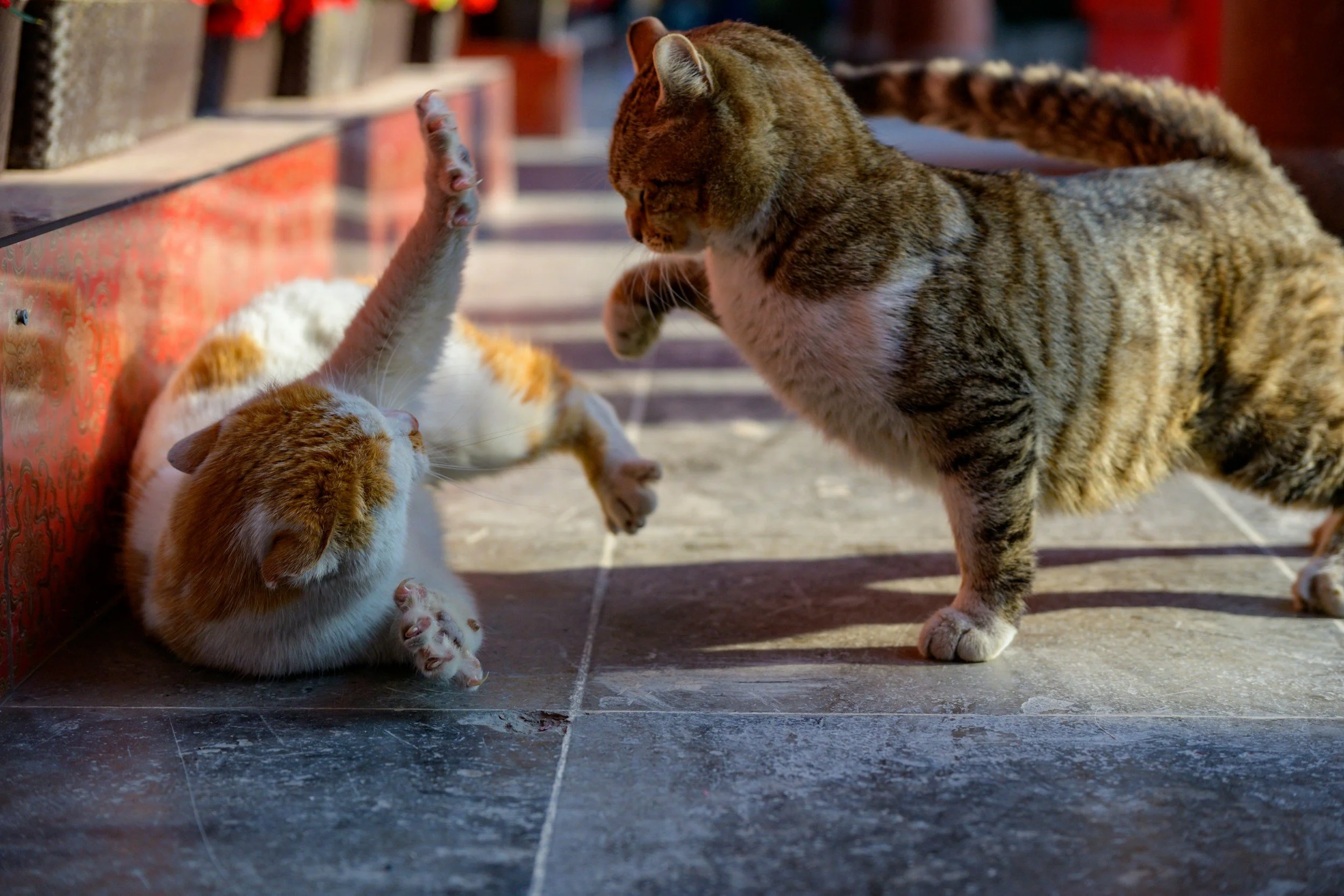
One of the most common questions clients, followers, and friends ask me is some version of, Are my cats playing… or are they fighting? And I completely understand why people ask. Cat play can look dramatic! There can be wrestling, bunny kicking, dramatic chase scenes through the house, little face slaps, and to the untrained eye it can all look a little chaotic. But the good news is that once you know what to look for, telling the difference is often much easier than people think.
The biggest clue I tell people to pay attention to is sound. Healthy cat play is almost always silent. It may look rough, but it tends to be quiet. You might hear feet thundering across the floor or the occasional excited squeak, but you generally shouldn’t be hearing hissing, growling, or yowling. Fighting is a different story! Fighting is usually noisy, and if vocalization enters the picture - especially hissing, growling, or yowling - that often means we’ve moved out of play.
Another thing I look for is turn taking. Healthy play has a kind of rhythm to it. One cat chases, then gets chased. One pounces, then gets pounced on. There are pauses in the action where both cats seem to reset and then choose to keep going. Those pauses matter. They’re part of consent, and consent is something we don’t talk about nearly enough in cat relationships.
And yes, play can still look rough. Several of our own cats LOVE roughhousing. Our young CH kitten, Egg, is probably the craziest member of the household and will launch herself at her giant 17-pound uncles, play biting and bunny kicking their stomachs like she’s wrestling a bear (she also isn’t afraid of bears when they visit our house). It can look absurd to an outsider. But it’s play because everyone involved is relaxed, there’s role reversal, there are breaks in the action, and there’s no escalation. When one cat is done, they simply walk away, and the other lets them. That, to me, is one of the most beautiful signs of healthy feline friendship: when a cat says, “I’m done playing,” the other respects it.
Cats often “ask” each other to play in subtle ways that people miss. There may be a little sideways lean, a playful bop, or a raised paw - almost like a feline version of a dog’s play bow. One cat invites, the other opts in. That’s very different from being ambushed in a hallway or pressured into an interaction. Mutual play is something both cats participate in willingly.
This is also where I start looking for subtle early signs of conflict, because those often show up before obvious fighting. Staring is a huge one, and it’s one people underestimate all the time. To humans, face-to-face attention feels friendly. To cats, prolonged staring can be incredibly rude and threatening. If one cat is habitually staring at another, I’d intervene there. Don’t wait for the chase or the fight. Staring often becomes the fight. The same goes for cornering, gatekeeping narrow spaces, or “surprising” another cat from behind a doorway or around a corner. Those aren’t normal parts of mutual play. Play is mutual; pressure is something else.
This is where I often see households drift into unhealthy predator-prey dynamics (and remember, cats are both predators and prey). One cat starts acting more like a pursuer while the other begins moving in increasingly small, skittish, prey-like ways. Unfortunately those fearful movements can actually trigger even more chasing and attacking. It can become a really unhealthy loop, and it’s something I encourage people to interrupt early.
People often ask me about chasing, because chasing can happen in both healthy play and conflict. My answer is always that context matters. If two cats have a wonderful relationship - they groom each other, nap together, sleep butt-to-butt (which, by the way, is elite friendship in cat language) - then chasing may be part of their play repertoire. Our orange boys Gene and Butters do this all the time! But if one of them started chasing one of our older females through the house, I’d read that very differently. Behavior doesn’t happen in a vacuum. Relationships matter.
Another important thing to understand is that even healthy play can occasionally tip into conflict. Cats can get overstimulated. Just like a cat who has enjoyed petting can suddenly get over-aroused and slap you, cats can get too amped up in play and take things too far. When that happens, I tell people to listen for vocalization, watch pupils, watch for skin rippling, and watch for that moment when the energy shifts. Often you can feel the change before a real fight happens. And if you see that shift, help them regulate. Interrupt gently, create calm, and let everybody come down. And please never put your hands into a cat fight.
One myth I really want to bust here is the idea that cats need to “work it out.” I hear this advice constantly, and it causes so much damage. Cats are generally not fighting to establish some dramatic dominance hierarchy. In fact, many households don’t even have a singular “dominant” cat. Cats often negotiate social order through subtle rituals - access to height, grooming patterns, feeding routines - not combat. If aggression is happening, help them! Don’t let them rehearse it. Redirect, de-escalate, and rebuild positive associations. And please skip punishment. Spray bottles, yelling, startling cats - those things often increase stress and damage trust. Positive reinforcement is the way through.
Sometimes the answer isn’t even behavior work as much as environmental setup. I often look at bottlenecks in the home. Where are cats getting trapped socially? Can we add vertical escape routes? Can we reduce pressure around litter boxes, feeding stations, or favorite resting spots? Sometimes something as simple as a cardboard box in a hallway can reduce conflict by adding height when cats pass each other (coming face to face). Seriously. Small changes can matter that much.
It’s also important to remember that social stress doesn’t always look like obvious fighting. Sometimes it looks like overgrooming, house soiling, hiding, hypervigilance, or a cat who just seems suddenly “off.” Those can be social stress signals too, and sometimes signs of bullying (they can also be signs of physical illness, so always get a vet checkup if you see these).
So when people ask me whether their cats are playing or fighting, I often gently shift the question, because sometimes the more important question is: Are my cats comfortable with each other? That’s really what we’re trying to assess. Healthy play is mutual, quiet, flexible, and respectful. Conflict is usually pressured, tense, and one-sided.
And if you’re ever unsure, zoom out and look at the relationship itself. The relationship will usually tell you the answer.
And the good news is that even if there is tension, relationships can improve. Cats can heal. We just have to set them up for success!
Frequently Asked Questions
Is it normal for cats to chase each other?
Sometimes, yes — especially between bonded cats with turn-taking and mutual play.Should I let my cats work out fights themselves?
No. True aggression should be interrupted safely and addressed.Is hissing during play normal?
Occasional mild protest can happen, but repeated hissing often signals discomfort or escalation.
Need help with your cat’s behavior?
I work with cat guardians worldwide on issues like:
• inter-cat aggression • house soiling • feline anxiety and so much more!